
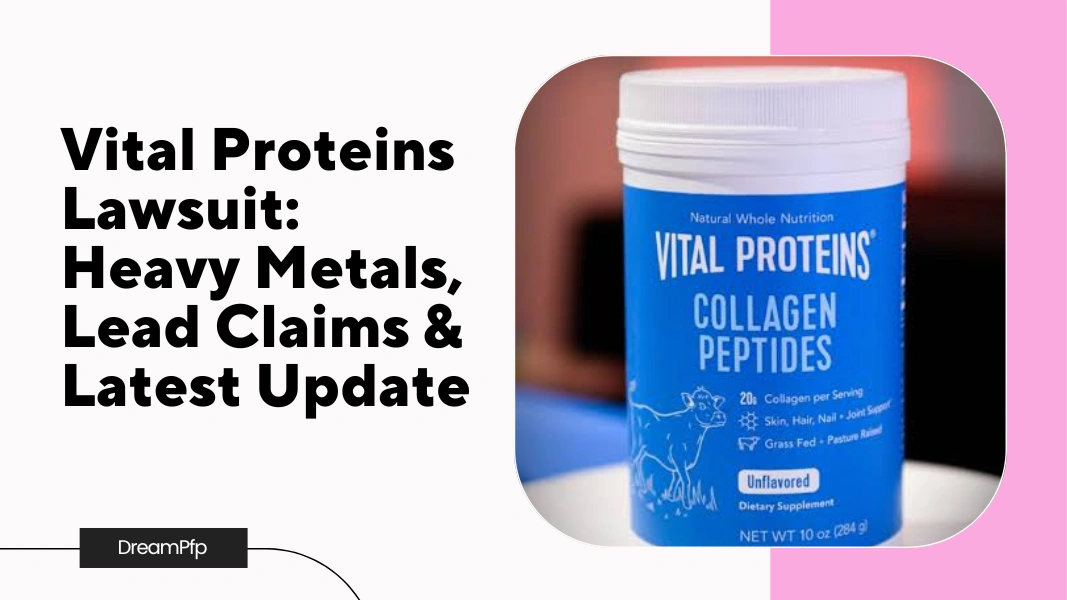
Vital Proteins is one of the best-known collagen supplement brands in the United States, but questions about heavy metals, California warning requirements, and past legal action have led consumers to search for information about the Vital Proteins Lawsuit. Much of the attention centers on allegations involving lead and cadmium in certain products.
People researching the issue often want to know whether a lawsuit was actually filed, whether Vital Proteins paid a settlement, how much lead was allegedly involved, and whether current collagen products are safe. These questions sometimes become mixed with a separate product recall.
The legal record provides more clarity than online rumors do. This article examines the documented Proposition 65 case, later regulatory notices, safety concerns, independent testing discussions, the 2023 recall, and what consumers should understand before drawing conclusions.
Why Did The Vital Proteins Lawsuit Become A Topic Of Discussion?

Discussion about Vital Proteins did not arise solely from social-media complaints. A documented California Proposition 65 enforcement action is an important part of the story.
In November 2017, the Environmental Research Center (ERC) filed a 60-day notice identifying Vital Proteins and alleging exposure to lead and cadmium from dietary supplements. A civil complaint followed in Alameda County Superior Court in May 2018. The stated claim was failure to warn under Proposition 65.
The case covered specific products rather than every collagen supplement sold by the company. The complaint identified products including certain flavored collagen peptides, Collagen Veggie Blend, and Collagen Whey formulations.
The dispute eventually resulted in a consent judgment. That history matters because online discussions sometimes describe the controversy as if a court determined that every Vital Proteins product was dangerously contaminated. The public record does not support such a broad conclusion.
A separate 2025 Proposition 65 notice also identified Vital Proteins and other parties in connection with alleged lead exposure from Vital Proteins Daily Greens and Plant Protein. The California Attorney General’s database indicates that this notice was partially withdrawn on June 1, 2026.
Understanding The Lead Warning Associated With Vital Proteins
California Proposition 65 requires businesses to provide warnings regarding significant exposures to chemicals the state identifies as causing cancer, birth defects, or reproductive harm, subject to applicable rules and exposure thresholds.
The 2018 Vital Proteins case focused on an alleged failure to provide required warnings for lead and cadmium exposure associated with certain supplements. It was therefore primarily a failure-to-warn case, not a personal-injury judgment finding that consumers had been poisoned.
Under the resulting consent judgment, beginning August 15, 2018, covered products sold into California that exposed a person to more than 0.5 micrograms of lead per day or more than 4.1 micrograms of cadmium per day had to comply with specified warning requirements.
That distinction is essential. A Proposition 65 warning threshold is not the same thing as a federal determination that a product is unsafe to consume. It is a California regulatory standard governing consumer warnings for chemical exposure.
What Is The Vital Proteins Heavy Metals Lawsuit About?
The phrase “Vital Proteins heavy metals lawsuit” generally refers to the Proposition 65 litigation filed by Environmental Research Center against Vital Proteins.
According to the California Attorney General’s records, ERC issued its notice in November 2017. The chemicals identified were lead, lead compounds, and cadmium, with dietary supplements listed as the source. A civil complaint was filed on May 17, 2018.
The case was resolved through a settlement and judgment rather than a trial verdict establishing that Vital Proteins caused physical injuries.
| Issue | Documented Status |
|---|---|
| Proposition 65 notice | Filed November 2017 |
| Civil complaint | Filed May 2018 |
| Main claim | Failure to warn |
| Chemicals identified | Lead and cadmium |
| Settlement | Reported June 2018 |
| Total payments | $92,500 |
| Judgment | August 2018 |
| Consumer injury verdict | Not established by this case |
California records report total payments of $92,500, including a $20,595 civil penalty, attorney fees and costs, and an additional settlement payment.
Calling the matter a heavy-metals lawsuit is therefore reasonable in general discussion, but it should not be presented as proof that all Vital Proteins products contain dangerous concentrations of heavy metals.
Why Can Collagen Supplements Contain Trace Heavy Metals?
Heavy metals are environmental contaminants that can occur naturally in soil, water, plants, and animal feed. As a result, trace amounts can sometimes enter foods and ingredients even when manufacturers do not intentionally add them.
Collagen products are typically produced from animal-derived materials. Vital Proteins’ current product information states that its bovine collagen is sourced from cattle and that collagen peptides are produced from animal by-products such as skins and hides.
Potential contamination can therefore depend on several variables, including:
- the geographic source of raw materials;
- environmental conditions affecting animals or plants;
- manufacturing and processing methods;
- ingredient concentration;
- batch-to-batch variation; and
- quality-control and contaminant testing.
Detection alone does not answer the safety question. The amount detected, serving size, frequency of use, applicable regulatory standard, and resulting exposure all matter.
This is also why testing one container or one historical batch cannot automatically establish the composition of every product a company currently sells.
How Much Lead Is In Vital Proteins Collagen Peptides?
There is no single reliable number that can be applied to every current Vital Proteins Collagen Peptides product or batch based on the public legal record reviewed for this article.
One figure frequently associated with the lawsuit is 0.5 micrograms of lead per day. However, that number should not be described as the amount of lead measured in every serving of Vital Proteins collagen.
Instead, the 2018 consent judgment used 0.5 micrograms per day as the relevant exposure level for determining whether covered products could be sold in California without the warning specified by the judgment. The corresponding cadmium level was 4.1 micrograms per day.
That is a significant legal distinction.
Heavy-metal concentrations may also differ among formulations and production lots. Consumers seeking information about a particular current container should look for recent batch-specific laboratory data rather than assuming historical litigation provides its present lead concentration.
Claims online that a specific amount of lead exists in “all Vital Proteins collagen” should therefore be treated cautiously unless they are supported by current, product-specific testing.
Does Detecting Lead Mean A Product Is Unsafe?
Not automatically. Laboratory equipment can detect extremely small concentrations of substances, so detection and demonstrated health danger are different questions.
Safety evaluation depends on dose and exposure. Factors such as how much of the substance is present, how frequently the product is consumed, the user’s overall exposure from other sources, and which regulatory benchmark is being applied can all influence the assessment.
At the same time, lead exposure is a legitimate public-health concern, and consumers should not dismiss contaminant testing simply because measured amounts are small.
The safest interpretation is therefore neither “any detectable lead proves the product is dangerous” nor “trace lead never matters.” A meaningful assessment requires actual laboratory results and appropriate toxicological or regulatory context.
This is particularly important with Proposition 65 disputes. California’s warning framework can trigger labeling obligations at exposure levels that consumers may encounter in discussions without understanding what those numbers legally represent.
The Role Of Independent Testing In The Controversy
Independent testing has become an important part of the supplement market because consumers cannot determine heavy-metal concentrations by looking at a powder, tasting it, or reading the basic Supplement Facts panel.
Testing can screen products for contaminants such as lead, cadmium, arsenic, and mercury. For consumers, the strongest information is generally recent, product-specific and preferably tied to an identifiable batch or lot.
Third-party certification can also provide additional quality assurance, although consumers should examine exactly what a certification covers. Different certification programs may test for different contaminants, prohibited substances, label accuracy, or manufacturing requirements.
Vital Proteins states that its Collagen Peptides are manufactured at a facility with NSF and SQF certifications. Current dietary supplement label records also identify bovine collagen peptides as the principal ingredient in common unflavored formulations.
None of these facts should be treated as a substitute for a current batch-specific contaminant result. When evaluating claims online, consumers should ask when the sample was tested, which formulation was tested, which laboratory performed the analysis, and what units were reported.
Has Vital Proteins Responded To Safety Concerns?
Vital Proteins publicly emphasizes sourcing, manufacturing standards, traceability, and product quality. Its website states that Collagen Peptides are manufactured in an NSF- and SQF-certified facility and describes initiatives intended to increase traceability across its collagen supply chain.
The company’s legal resolution of the 2018 Proposition 65 case also established specific compliance obligations for the products covered by the consent judgment.
Beginning August 15, 2018, the judgment restricted sales of covered products in California when exposures exceeded the specified lead or cadmium levels unless the required warning conditions were satisfied.
This should not be interpreted as an admission that every Vital Proteins product was unsafe. Consent judgments commonly resolve regulatory disputes without requiring a trial on every contested factual question.
Consumers evaluating the brand today should therefore distinguish the historical legal settlement from claims about current products. Recent product labels, manufacturing information, lot-specific test results, recalls, and current regulatory notices are more relevant to the safety of a container being sold now.
Vital Proteins Lawsuit Update
As of 2026, the most clearly documented heavy-metals litigation remains the 2018 California Proposition 65 case involving Environmental Research Center and Vital Proteins.
That case was settled. California’s records show a June 1, 2018 settlement and an August 3, 2018 judgment. Total payments were reported as $92,500, while the consent judgment established warning-related requirements for covered products exceeding specified exposure levels.
There has also been more recent Proposition 65 activity. A 2025 notice identified Vital Proteins LLC, NHS U.S. LLC, and several retailers and alleged lead exposure involving Vital Proteins Daily Greens and Plant Protein. The Attorney General’s database currently states that the notice was partially withdrawn on June 1, 2026.
These developments should not be collapsed into a single nationwide class action. The 2018 proceeding was a California Proposition 65 enforcement matter, while a 60-day notice is itself a pre-suit enforcement notice and does not necessarily mean a lawsuit ultimately produced a judgment.
Consumers should also be cautious with websites claiming that a new nationwide settlement, compensation program, or claim form exists unless those claims can be verified through court records or official settlement materials.
Has There Been A Product Recall?
Yes. Vital Proteins has been associated with a documented product recall, but the widely reported 2023 recall was not a heavy-metals recall.
A single batch of 24-ounce Vital Proteins Collagen Peptides sold through Costco was voluntarily recalled because pieces of a broken blue plastic lid might have entered one or more canisters. The affected batch was 30095993HA, with a best-by date of January 9, 2028.
Reports indicated that nearly 60,000 canisters were involved and that the FDA classified the action as a Class II recall. No injuries had been reported in connection with the issue at the time of the recall reporting.
The distinction matters because online discussions sometimes combine the recall and the earlier Proposition 65 litigation into one event.
They involved different concerns:
- 2017–2018 legal action: alleged lead and cadmium warning violations.
- 2023 recall: possible pieces of broken plastic from a lid.
The 2023 recall therefore should not be cited as evidence that the recalled batch contained excessive lead.
Is Vital Proteins Safe Now?
There is no responsible way to classify every Vital Proteins product and every batch as universally “safe” or “unsafe” based solely on the historical lawsuit.
The 2018 Proposition 65 case addressed specified products and warning obligations. Current Vital Proteins formulations, batches, and manufacturing practices should be evaluated using current information rather than assuming that conditions documented years ago remain unchanged.
Vital Proteins says its collagen peptides are manufactured at an NSF- and SQF-certified facility. Current NIH dietary supplement label records describe common Collagen Peptides formulations as bovine collagen peptide products and include standard precautions for certain consumers.
Consumers who are particularly concerned about heavy metals can take additional steps, such as requesting a certificate of analysis or other contaminant-testing information for the relevant product, checking current recalls, and comparing third-party testing standards.
Pregnant or nursing consumers, people with medical conditions, and anyone concerned about cumulative exposure should discuss supplement use with an appropriate healthcare professional. Product safety is an individualized health question as well as a regulatory one.
What Reddit Discussions Say About Vital Proteins
Reddit discussions show why the Vital Proteins controversy continues to attract searches, but they also demonstrate the limitations of relying on social media for legal or scientific conclusions.
Users have repeatedly asked whether Vital Proteins collagen contains lead, whether they should switch brands, and which collagen products provide better heavy-metal testing transparency. Some commenters reference the historical Proposition 65 case, while others discuss certifications or request certificates of analysis.
Other discussions contain conflicting interpretations. Some users view any reported lead as a reason to avoid a product, while others argue that environmental contaminants can appear at trace levels in many foods and supplements.
Reddit is useful for identifying consumer concerns, not establishing laboratory facts.
A post saying that someone “heard Vital Proteins has lead” does not establish the concentration, product, lot number, test method, or health significance. Likewise, a positive personal experience cannot establish that every batch meets a particular contaminant threshold.
For legal and safety research, court records, regulatory notices, recall information, product-specific laboratory reports, and professional medical guidance carry substantially more weight.
How Consumers Can Evaluate Collagen Supplements
Consumers comparing collagen products should look beyond marketing terms such as “premium,” “clean,” or “grass-fed.” Those descriptions may tell buyers something about sourcing, but they do not independently establish contaminant levels.
A more useful evaluation includes:
- checking whether the manufacturer provides recent third-party testing;
- looking for certificates of analysis tied to specific lots;
- reviewing testing for lead, cadmium, arsenic, and mercury;
- checking current FDA or retailer recall notices;
- confirming the collagen source and other ingredients;
- reviewing serving size and recommended use; and
- verifying what any third-party certification actually tests.
Consumers should also distinguish between concentration and exposure. A laboratory result expressed in parts per million, for example, cannot be meaningfully compared with a micrograms-per-day exposure threshold without considering serving size and other relevant factors.
Anyone using collagen every day may reasonably want more transparency than someone making an occasional purchase. When laboratory reports are available, the testing date, laboratory identity, detection limits, product formulation, and lot number can be as important as the headline result.
Why Heavy Metal Testing Matters Across The Supplement Industry
Heavy-metal concerns extend beyond Vital Proteins. Dietary supplements can contain ingredients derived from plants, minerals, marine organisms, or animals, all of which may be exposed to naturally occurring or environmental contaminants.
That makes supplier controls and testing important throughout the supplement industry.
Testing is particularly valuable when products are consumed regularly because repeated exposure can change the practical significance of small contaminant amounts. Manufacturers can reduce uncertainty through raw-material screening, finished-product testing, supplier qualification, traceability, and transparent quality-control procedures.
Consumers should nevertheless avoid assuming that one brand’s legal dispute proves that competing products contain no heavy metals. Switching products without reviewing comparable testing may simply replace one unknown with another.
The broader lesson from the Vital Proteins dispute is therefore about transparency. Clear test methods, identifiable batches, current certificates of analysis, and understandable contaminant limits give consumers far more useful information than broad claims such as “toxin-free.”
Legal compliance and product quality are also separate concepts. A product can comply with a particular labeling rule without necessarily being the best choice for every individual consumer.
Consumer Takeaways
The Vital Proteins controversy is based partly on documented legal events and partly on broader online discussion. Keeping those categories separate prevents the facts from becoming exaggerated.
The most important confirmed points are straightforward. Environmental Research Center brought a California Proposition 65 case against Vital Proteins involving alleged exposure to lead and cadmium without required warnings. The case resulted in a 2018 settlement and judgment with total payments reported at $92,500 and compliance requirements for covered products.
A separate 2025 Proposition 65 notice concerned alleged lead exposure associated with Daily Greens and Plant Protein, and California records indicate that notice was partially withdrawn in June 2026.
The 2023 Collagen Peptides recall is also real, but it involved potential plastic fragments from a broken lid rather than heavy-metal contamination.
Consumers concerned about a current product should focus on its exact formulation and lot, recent laboratory data, official recall information, and professional health guidance rather than treating historical litigation or social-media claims as proof about every product sold today.
Read: Symmetry Financial Group Lawsuit
Read: Chobani Yogurt Lawsuit 2026
Read: Zoloft While Breastfeeding Lawsuit
Read: Vegamour Lawsuit
Read: RPM Living Lawsuit
Read: Dan Survivor 39 Lawsuit
Read: Tax Rise Lawsuit
Read: NetVideoGirls Lawsuit
Read: Credit One Bank Class Action Settlement
Read: Ryze Superfoods Lawsuit
Frequently Asked Questions
Is there really a Vital Proteins lawsuit?
Yes. A documented California Proposition 65 lawsuit was filed against Vital Proteins in 2018 after a 2017 notice alleging exposure to lead and cadmium from certain dietary supplements without required warnings. The case was resolved through a settlement and consent judgment.
Did Vital Proteins settle the lawsuit?
Yes. California Attorney General records show that the Environmental Research Center case reached a settlement in June 2018, followed by a judgment in August. The public record lists total payments of $92,500 and includes warning-related injunctive requirements for covered products.
Does Vital Proteins Collagen Peptides contain lead?
The historical legal action involved allegations concerning lead in specified Vital Proteins products, but it does not establish one current lead concentration applicable to every Collagen Peptides product or batch. Consumers seeking a precise current figure need recent product- or lot-specific laboratory testing.
Was the Vital Proteins recall caused by heavy metals?
No. The widely reported 2023 recall involved possible pieces of a broken blue plastic lid in one batch of 24-ounce Collagen Peptides sold through Costco. It was separate from the earlier lead and cadmium Proposition 65 dispute.
Is there a Vital Proteins class action settlement claim form?
The documented 2018 matter discussed here was a Proposition 65 enforcement case, not a nationwide consumer compensation class action. Consumers should not assume they are entitled to a payout merely because they purchased Vital Proteins. Any legitimate claim process should be verified through official court or settlement records.
What was the Vital Proteins lawsuit settlement amount?
California’s Proposition 65 database reports $92,500 in total payments for the 2018 settlement. That included a $20,595 non-contingent civil penalty, attorney fees and costs, and an additional settlement payment. It should not be confused with compensation paid to individual purchasers.
Should consumers stop using Vital Proteins because of the lawsuit?
The historical lawsuit alone cannot determine whether a particular current product is appropriate for an individual. Consumers concerned about lead or other contaminants can review current testing information, certifications and recalls and ask the manufacturer for lot-specific data. Medical concerns should be discussed with a qualified healthcare professional.
What is the latest legal status of the Vital Proteins heavy metal controversy?
The 2018 Proposition 65 case was settled and resulted in a judgment. A later 2025 Proposition 65 notice identified alleged lead exposure involving Daily Greens and Plant Protein, but the California Attorney General’s database states that the notice was partially withdrawn on June 1, 2026.
Final Thoughts
The Vital Proteins Lawsuit is not simply an internet rumor. Public California records confirm a Proposition 65 enforcement case involving allegations that certain Vital Proteins supplements exposed consumers to lead and cadmium without required warnings. That case ended in a 2018 settlement and judgment rather than a trial verdict establishing consumer injuries.
At the same time, the legal record should not be stretched beyond what it proves. It does not establish that every current Vital Proteins product contains unsafe heavy-metal levels. The separate 2023 recall involved potential plastic contamination, while more recent Proposition 65 activity has involved different products.
Consumers should evaluate current products using current evidence: lot-specific testing where available, official regulatory records, recalls, reliable certifications, and medical advice when appropriate. In supplement disputes, allegations, warning requirements, settlements, recalls, and proven health effects are distinct issues and should be reported that way.
