
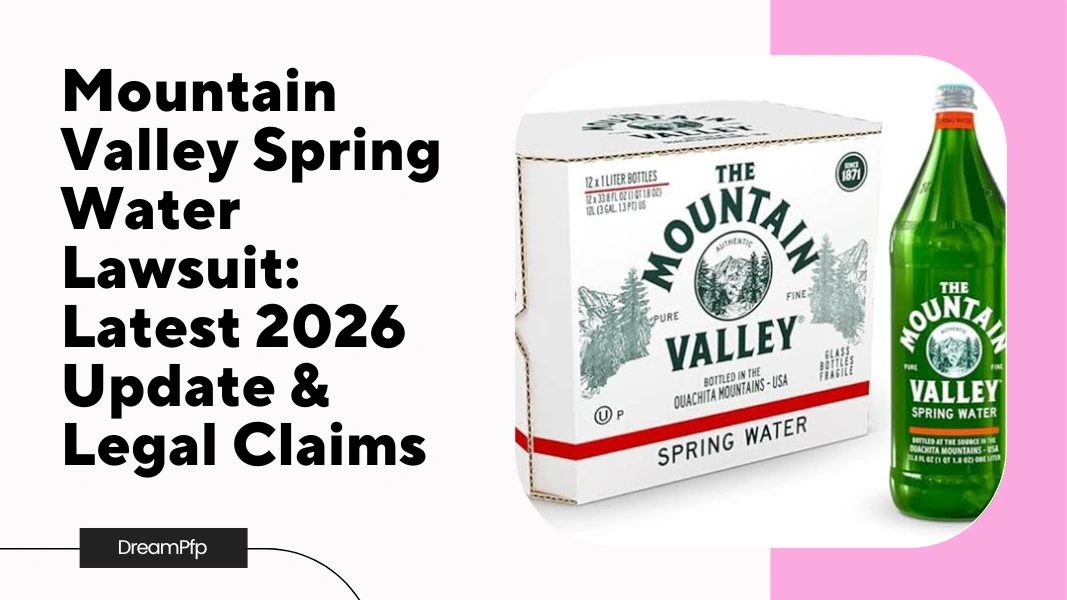
Mountain Valley Spring Water has long been marketed as a premium American spring water sourced from Arkansas. The Mountain Valley Spring Water Lawsuit has brought new attention to the brand after a proposed class action challenged certain purity and quality representations and alleged that testing detected substances consumers were not expecting in a premium bottled-water product.
Consumers searching the topic often want to know whether a lawsuit is actually pending, whether the allegations mean the water is unsafe, whether a settlement or payout exists, and whether Mountain Valley products have been recalled. Those questions require separating allegations in a civil complaint from established regulatory findings.
This article reviews the current case, the claims being made, publicly available quality information, consumer reviews, recall questions, and what buyers should consider while the litigation remains unresolved.
What Is the Mountain Valley Spring Water Lawsuit About?

The current Mountain Valley Spring Water Lawsuit centers on Nadel v. Primo Water Corporation, et al., case number 9:25-cv-80993. The proposed class action was filed on August 11, 2025, in the U.S. District Court for the Southern District of Florida. The named defendants include Primo Water Corporation, Primo Water North America, Inc., and Mountain Valley Spring Company, LLC.
Plaintiff Jeffrey Nadel alleges that Mountain Valley Spring Water was marketed using representations about purity and healthfulness while independent testing allegedly detected substances including arsenic, uranium, bromoform, and cadmium. The complaint argues that these alleged findings conflict with representations consumers encountered when purchasing the premium-priced water.
Importantly, these are allegations, not judicial findings. The filing of a complaint does not establish that the defendants violated the law, that the water is legally unsafe, or that every bottle contains the substances at issue.
As of the latest publicly accessible information reviewed for this article, the litigation remains described as a proposed class action. No final judgment or consumer settlement has been established in the sources reviewed.
| Question | Current Status |
|---|---|
| Lawsuit filed? | Yes |
| Case | Nadel v. Primo Water Corporation, et al. |
| Case number | 9:25-cv-80993 |
| Court | U.S. District Court, Southern District of Florida |
| Proposed class action? | Yes |
| Class certified? | Not confirmed in reviewed sources |
| Settlement announced? | No confirmed settlement in reviewed sources |
| Automatic payout available? | No confirmed payout program |
Why Has the Mountain Valley Spring Water Brand Faced Public Controversy?
The controversy goes beyond the existence of a court case. Mountain Valley occupies the premium end of the bottled-water market, where consumers may pay more because of perceived differences in source, mineral profile, packaging, taste, and purity.
That positioning makes marketing representations especially important. When consumers believe they are paying a premium because a product offers superior characteristics, allegations challenging those characteristics can become central to a deceptive-marketing lawsuit.
At the same time, online discussions have amplified concerns that have not necessarily been verified through regulatory action or court findings. Reviews, Reddit posts, independent tests, company reports, and lawsuit allegations therefore need to be evaluated separately.
Marketing and Advertising Claims
Mountain Valley promotes its water as spring water originating in Arkansas’s Ouachita Mountains. Its website says the water rises naturally, is bottled at the source, and travels through granite-based aquifers that contribute naturally occurring minerals.
The lawsuit challenges aspects of the purity-related marketing. According to the complaint, the plaintiff contends that alleged laboratory findings are inconsistent with representations concerning the product’s exceptional purity and absence of pollutants.
That distinction matters legally. The case is not simply about whether trace substances can be detected. It also concerns what reasonable consumers allegedly understood from the product’s marketing and whether those representations influenced purchasing decisions.
Premium Pricing
Premium pricing forms another part of the plaintiff’s theory.
A consumer-protection lawsuit may argue that purchasers would not have bought a product—or would have paid less—if they had known information that was allegedly omitted or misrepresented. This is often described as a price-premium theory of economic injury.
The complaint reportedly argues that consumers paid substantially more for Mountain Valley because they believed they were receiving water with the qualities advertised by the defendants.
Whether that theory succeeds depends on evidence, the applicable consumer-protection law, class-certification requirements, and ultimately the court’s treatment of the claims.
Online Consumer Discussions
Online conversations have expanded since the lawsuit became public. Some reviewers and Reddit users have questioned taste, packaging, delivery service, bottle seals, or perceived changes in the product.
For example, Reddit discussions include anecdotal complaints about unusual taste, delivery problems, and bottles that users believed were improperly sealed. Other users continue to describe positive experiences with the product.
These accounts can help identify what consumers are discussing, but they are not scientific evidence. An individual post cannot establish contamination, causation, regulatory noncompliance, or liability.
Understanding the Legal Claims Involving Mountain Valley Spring Water
The proposed class action is primarily framed as a consumer-protection dispute involving allegedly misleading marketing rather than a finding by a court that Mountain Valley caused physical injuries.
According to reports describing the complaint, the plaintiff alleges that laboratory testing detected arsenic, uranium, bromoform, and cadmium. The complaint further argues that certain detected substances conflict with the purity-related representations used to promote the water.
The case references EPA Maximum Contaminant Level Goals for some substances. A critical distinction, however, is that an MCLG is a non-enforceable public-health goal, not necessarily the same thing as the enforceable regulatory limit applicable to a bottled-water product. Therefore, detecting a substance for which an MCLG is zero does not by itself prove that a bottled-water product violates federal law.
The plaintiff’s claims reportedly include allegations under Florida consumer-protection law and theories concerning misleading representations and economic loss.
For consumers, the most important legal point is straightforward: the complaint states one side’s allegations. Unless admitted, settled, or proven through litigation, those allegations should not be treated as established facts.
Mountain Valley Spring Water Controversy Explained
The controversy involves several overlapping issues that can easily become confused online.
First is the lawsuit itself. A proposed class action has been filed and alleges that consumers were misled about characteristics of Mountain Valley Spring Water. That filing is real and identifiable through case number 9:25-cv-80993.
Second is the question of testing. The plaintiff relies on alleged independent testing, while Mountain Valley has historically published its own water-quality information and says its testing complies with applicable FDA standards. The company states that it regularly evaluates its water for regulated contaminants.
Third is the broader online debate over what constitutes “safe,” “pure,” or “contaminated” water. These terms can have very different meanings in advertising, toxicology, laboratory analysis, and regulatory law.
Detectability is also different from regulatory noncompliance. Modern laboratories can identify substances at extremely low concentrations. The relevant questions include the amount detected, the applicable legal standard, the testing methodology, and what representations were made to purchasers.
Those distinctions will likely remain important as the litigation develops.
Latest Mountain Valley Spring Water Lawsuit Update
The key case is Nadel v. Primo Water Corporation, et al., filed August 11, 2025, in federal court in Florida. Public case-tracking sources identify it as a class-action matter involving allegations characterized as fraud or deceptive marketing.
As of the latest sources reviewed in 2026, the case has been described as pending, with no reported final settlement, dismissal, or class certification. A legal information source updated in June 2026 similarly reported that no settlement had been reached at that stage.
That means consumers should be cautious about websites or social-media posts suggesting that everyone who purchased Mountain Valley can already submit a claim for money.
At this stage, there is no confirmed settlement fund, court-approved settlement claim form, or established per-person payout identified in the sources reviewed.
A proposed class action can change considerably after filing. Claims can be narrowed or dismissed, parties may settle, or the plaintiff may eventually seek class certification. Until those events occur, estimates of compensation are speculative.
Is Mountain Valley Spring Water Safe to Drink?
The lawsuit should not automatically be interpreted as an official determination that Mountain Valley Spring Water is unsafe to drink.
The complaint alleges that testing detected certain substances and argues that the findings undermine the product’s marketing. The defendants’ liability, however, has not been established merely because the complaint was filed.
Mountain Valley states that its spring source is monitored and its water is tested for contaminants. The company has also said its testing has not detected contaminants above FDA allowable limits. That is the company’s position and should be distinguished from the plaintiff’s allegations.
Bottled water in the United States is regulated by the FDA as a food product. Safety analysis depends on concentration, exposure, applicable standards, and reliable laboratory methodology—not simply whether a chemical can be detected.
Consumers with a bottle that appears damaged, unsealed, discolored, unusually odorous, or otherwise abnormal should avoid consuming it until the issue is resolved. Mountain Valley provides a mechanism for reporting specific water-quality concerns.
What Does the Mountain Valley Spring Water Quality Report Show?
Mountain Valley makes water-quality information available to consumers and provides access to a water quality report through its website. The reports are useful because they provide a more detailed picture than marketing language alone.
Historical reports describe mineral composition, physical characteristics, inorganic substances, radiological testing, and other parameters. They also describe how the water is sourced and tested.
Consumers should still pay attention to the report’s year and product type. A historical report cannot automatically establish the composition of every bottle sold years later.
Mineral Content
Mountain Valley naturally contains dissolved minerals acquired as the water moves through underground geological formations.
Company information based on previous quality reports has listed calcium at approximately 67 mg/L, magnesium around 7 mg/L, and potassium around 1–1.4 mg/L. Total dissolved solids have historically been reported at roughly 220 mg/L.
These minerals contribute to the water’s taste and composition.
Mineral content itself should not be confused with the contaminants alleged in the lawsuit. They are separate analytical issues and should be evaluated using appropriate concentration measurements and regulatory standards.
Water Source
Mountain Valley says its spring water originates in the Ouachita Mountains near Hot Springs, Arkansas.
According to the company, water passes through underground geological formations before naturally reaching the spring. The source is surrounded by approximately 2,000 acres of protected forest, and the brand says it has bottled water from the Arkansas source since 1871.
The source story is an important part of Mountain Valley’s premium positioning.
It is also relevant to the lawsuit because the plaintiff’s consumer-protection theory focuses partly on whether purchasers received what they reasonably understood from representations about purity, natural sourcing, and quality.
Laboratory Testing
Water testing can cover microbiological organisms, metals, inorganic chemicals, organic compounds, disinfection byproducts, radiological substances, and physical characteristics.
Mountain Valley states that its water is regularly tested and that its production process includes filtration, ultraviolet treatment, and ozonation.
The current lawsuit relies on separate alleged testing that the plaintiff says detected substances including arsenic, uranium, bromoform, and cadmium.
These competing pieces of information should not be collapsed into a simple “safe” or “unsafe” conclusion. Testing date, sample selection, laboratory methods, concentrations, detection limits, and applicable standards all matter.
Regulatory Compliance
Bottled water sold in interstate commerce falls under FDA regulation rather than the EPA framework that directly regulates public drinking-water systems.
This distinction is important because online discussions sometimes compare laboratory results directly with EPA goals without explaining how bottled-water regulations work.
Mountain Valley states that it follows FDA requirements and that its testing has not identified contaminants above FDA allowable limits.
The lawsuit challenges the company’s marketing and raises questions about alleged contaminant detections, but filing a consumer class action is not equivalent to an FDA enforcement determination.
Consumers evaluating the dispute should therefore distinguish between health goals, enforceable standards, company test results, independent laboratory findings, and allegations made in litigation.
What Do Mountain Valley Spring Water Reviews Say?
Consumer reviews are mixed and often focus on issues that have little to do with the legal case.
Some purchasers appreciate Mountain Valley for its mineral-forward flavor, glass packaging, and spring source. A bottled-water taste comparison published in 2025 ranked Mountain Valley eighth among the products discussed and characterized it as having a noticeable mineral profile.
Other recent online reviewers have complained about price, taste, packaging changes, aluminum caps, and perceived changes in water quality. Some reviewers explicitly mention the lawsuit or contamination concerns.
Reviews should be treated as individual experiences rather than proof.
A consumer saying that water “tastes different,” for example, does not establish chemical contamination. Taste can be influenced by mineral composition, temperature, storage, packaging, individual sensitivity, and other factors.
Reviews are most useful for identifying recurring consumer concerns. Laboratory testing, regulatory records, and court documents carry substantially more weight when evaluating legal or safety claims.
What Are People Saying About Mountain Valley Spring Water on Reddit?
Reddit discussions show a broad range of opinions about Mountain Valley.
Some users have historically praised the water and discussed choosing it because of its glass packaging or spring source. Others have raised concerns about unusual taste, delivery reliability, bottle seals, and perceived changes in quality.
More recent discussions also reference the class-action allegations. That has contributed to uncertainty among consumers who previously considered the brand a premium option.
Reddit can provide useful insight into consumer sentiment, but it is particularly important not to treat anonymous posts as verified evidence. Claims about contamination, bottling practices, product substitutions, or health effects may be incorrect or unsupported.
Consumers investigating a specific bottle should record the lot information, retain the packaging where appropriate, contact the seller or manufacturer, and rely on verified recall notices and laboratory or regulatory information rather than social-media speculation.
Has Mountain Valley Spring Water Ever Been Recalled?
A lawsuit and a product recall are two different legal and regulatory events.
The current proposed class action does not, by itself, constitute a recall. A civil plaintiff can file allegations against a manufacturer without an FDA recall being initiated.
A search of the sources reviewed for this article did not identify a current nationwide FDA recall of Mountain Valley Spring Water tied to the allegations in Nadel v. Primo Water Corporation. Consumers should therefore avoid interpreting posts about the lawsuit as proof that all Mountain Valley products have been recalled.
Recall status can change, however, and old or unrelated notices can circulate online without context.
For the most reliable information, consumers should verify the product name, package size, UPC, lot number, production date, and recall date against an official regulatory notice or manufacturer announcement.
If an official recall is eventually issued, the notice should identify the specific products affected rather than requiring consumers to assume that every Mountain Valley product is included.
What Should Consumers Do If a Mountain Valley Spring Water Recall Is Announced?
If an official Mountain Valley Spring Water recall is announced, consumers should follow the instructions contained in the actual recall notice.
The first step is to determine whether the bottle or case in their possession matches the affected product identifiers. Recalls frequently apply only to certain production runs rather than an entire brand.
Useful steps may include:
- Stop consuming the affected product.
- Check the lot, batch, UPC, and package size.
- Keep the bottle or packaging if instructed.
- Save the purchase receipt when available.
- Follow official return or disposal instructions.
- Contact the manufacturer or retailer regarding refunds.
- Seek appropriate medical advice if symptoms or exposure concerns arise.
Consumers should avoid relying exclusively on screenshots or reposted social-media notices. The original FDA notice or official manufacturer communication provides more reliable information about which products are affected and what action is recommended.
A recall also does not automatically establish civil liability. The legal consequences depend on why the recall occurred, the evidence available, and whether consumers suffered compensable losses.
Why Premium Bottled Water Companies Can Face Lawsuits
Premium bottled-water companies sell more than basic hydration. Their pricing frequently depends on representations concerning origin, purity, mineral composition, environmental practices, processing methods, packaging, or health-related qualities.
That creates potential consumer-protection exposure when purchasers allege those representations are inaccurate or materially incomplete.
Common legal theories can involve:
- False or misleading advertising
- Deceptive trade practices
- Misrepresentation of product characteristics
- Failure to disclose material information
- Breach of warranty
- Economic loss based on a price premium
Not every inaccurate statement creates a successful lawsuit. Plaintiffs generally must satisfy the elements of the particular cause of action and establish issues such as materiality, injury, causation, and damages.
Class actions add another layer. Even when an individual plaintiff has a viable claim, a court must separately determine whether the requirements for class treatment are satisfied.
That is why the filing of a proposed class action should never be reported as if a nationwide group of consumers has already won compensation.
What Should Consumers Consider Before Buying Mountain Valley Spring Water?
Consumers deciding whether to continue purchasing Mountain Valley can evaluate the available information rather than relying on either marketing claims or alarming online posts alone.
Start with the current water-quality report. Compare reported concentrations with the appropriate bottled-water standards, and pay attention to the testing date and the specific product analyzed.
Other practical considerations include:
- Source and bottling information
- Current water-quality reports
- Applicable FDA standards
- Packaging preference
- Mineral composition
- Taste and price
- Any official recall notices
- Developments in the pending litigation
Consumers concerned specifically about the lawsuit should remember that its allegations remain subject to the judicial process.
Those with an unusual bottle—such as a broken seal, strange odor, unexpected appearance, or damaged packaging—have a different issue from someone merely evaluating the lawsuit. The company provides a water-quality reporting channel for specific product concerns.
How Bottled Water Companies Typically Respond to Consumer Lawsuits
A bottled-water company facing a consumer class action has several potential responses.
The defendants may dispute the plaintiff’s interpretation of testing results, challenge whether advertising was misleading, argue that the product complied with applicable regulations, or contend that consumers did not suffer legally cognizable damages.
Procedurally, defendants may seek dismissal of some or all claims before extensive discovery occurs. If claims survive, the parties can exchange evidence, obtain expert testimony, litigate class certification, negotiate a settlement, or eventually proceed toward trial.
Regulatory compliance can be important, but it does not necessarily end every advertising case. A product may satisfy a regulatory standard while a plaintiff separately argues that particular marketing language gave consumers a misleading impression.
Likewise, detecting a substance does not automatically establish liability. Courts may need to consider concentration, testing methodology, the exact wording of advertisements, reasonable consumer expectations, and whether the alleged misrepresentation caused economic harm.
The outcome of the Mountain Valley litigation will depend on those types of evidentiary and legal questions rather than public opinion alone.
Could Future Mountain Valley Spring Water Lawsuits Be Filed?
Additional lawsuits are possible, but they should not be predicted as inevitable.
Consumers can bring claims when they believe they have suffered legally recognized injuries, and lawyers sometimes file related actions after allegations involving a widely sold consumer product become public. Related cases can also be consolidated or otherwise coordinated.
Future claims could theoretically concern advertising, warranty issues, economic losses, or alleged personal injuries. Each type of case would require its own factual and legal support.
A personal-injury claim, for example, would generally require substantially more than proof that someone purchased the water. Questions involving exposure, actual injury, medical evidence, and causation could become central.
Consumers should also be skeptical of websites suggesting that merely buying Mountain Valley automatically entitles someone to compensation. Unless a class is certified or a settlement creates an eligible claimant group, there is no automatic right to a payout simply because a proposed class action exists.
Read: Vital Proteins Lawsuit
Read: SheaMoisture Lawsuit
Read: Capital Vacations Class Action Lawsuit
Read: Prose Hair Lawsuit
Read: Revive Essential Oils Lawsuit
Read: Dan Survivor 39 Lawsuit
Read: Tax Rise Lawsuit
Read: NetVideoGirls Lawsuit
Read: Credit One Bank Class Action Settlement
Read: Ryze Superfoods Lawsuit
Frequently Asked Questions
Is there currently a Mountain Valley Spring Water class action lawsuit?
Yes. Nadel v. Primo Water Corporation, et al. was filed in August 2025 in the U.S. District Court for the Southern District of Florida. It is identified as case 9:25-cv-80993 and challenges alleged representations concerning Mountain Valley Spring Water’s purity and quality.
What contaminants does the lawsuit allege were found?
The complaint alleges that independent laboratory testing detected substances including arsenic, uranium, bromoform, and cadmium. These are plaintiff allegations and have not been converted into a final judicial finding that the defendants violated applicable bottled-water safety standards.
Has the Mountain Valley Spring Water lawsuit settled?
No confirmed settlement was identified in the latest sources reviewed for this article. Reporting from June 2026 described the litigation as pending without a settlement or class-certification decision. Consumers should be cautious about unofficial websites advertising guaranteed settlement payments.
Is there a Mountain Valley Spring Water lawsuit claim form?
There is no court-approved settlement claim form identified in the sources reviewed. A law firm’s informational page concerning the pending litigation should not be confused with an official settlement administrator’s claim form. A genuine settlement process would normally follow court approval and provide defined eligibility requirements and deadlines.
How much is the Mountain Valley Spring Water lawsuit payout?
No established per-person payout has been announced. Because there is no confirmed settlement fund in the sources reviewed, any specific dollar amount circulating online should be treated as speculative unless supported by an official court-approved settlement notice.
Does the lawsuit mean Mountain Valley Spring Water is unsafe?
No. Filing a lawsuit does not itself establish that a product is unsafe. The complaint raises allegations based on reported testing, while Mountain Valley has stated that its testing meets applicable FDA standards. Safety questions should be evaluated using reliable testing, concentrations, regulatory standards, and current official information.
Has Mountain Valley Spring Water been recalled because of the lawsuit?
The reviewed sources did not identify a current nationwide FDA recall tied to the allegations in the pending case. A lawsuit is not the same as a recall. Consumers who encounter a recall claim should verify the product and lot information through official regulatory or manufacturer information.
Final Thoughts
The Mountain Valley Spring Water Lawsuit is a real proposed federal class action, not merely an online rumor. The plaintiff alleges that testing detected certain substances despite marketing that presented Mountain Valley as an exceptionally pure premium spring water. Those allegations remain subject to litigation and should not be described as proven misconduct.
At present, consumers should also distinguish the lawsuit from a settlement or recall. The sources reviewed do not establish a court-approved consumer settlement, confirmed payout amount, or lawsuit-related nationwide recall.
Anyone evaluating the product can review current quality reports, official regulatory information, and future court developments rather than relying solely on reviews or social-media claims. Ultimately, whether the defendants face liability—and whether consumers become eligible for compensation—will depend on evidence, applicable law, class-certification decisions, and the outcome of the federal case.
