
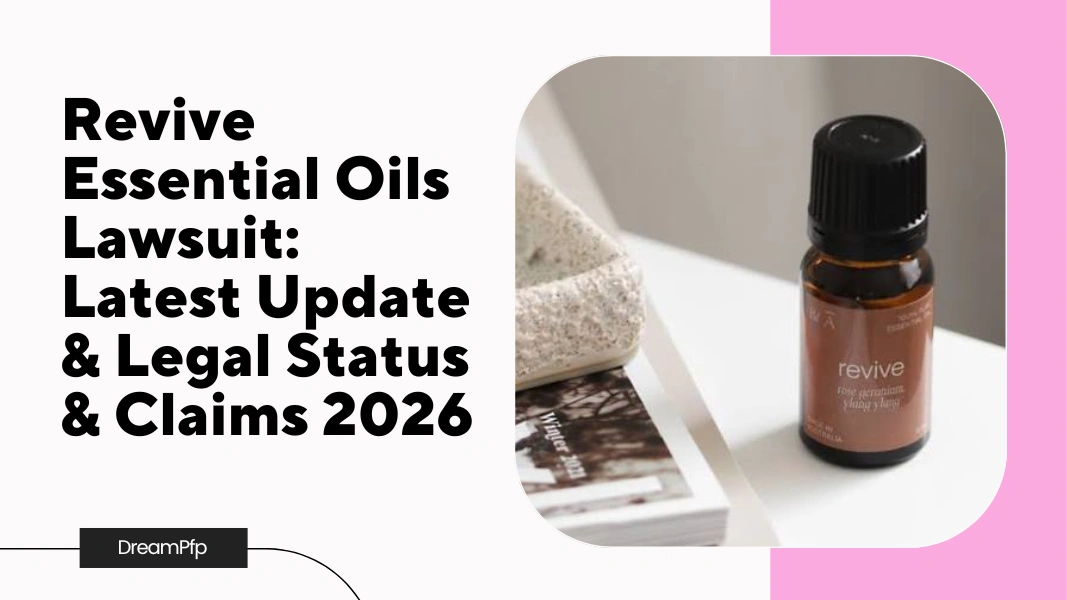
Revive Essential Oils has attracted attention from consumers looking for affordable alternatives to established essential-oil brands. Searches for the Revive Essential Oils Lawsuit often mix several different subjects, including an older trademark dispute, product-safety concerns, reviews, and newer court filings.
People also want to know whether Revive faces a consumer class action, whether a settlement exists, and whether buyers can submit compensation claims. Those questions require care because online articles do not always distinguish verified court proceedings from speculation or unrelated complaints.
This article examines the publicly documented litigation involving Revive, its federal product recall, comparisons with Young Living and doTERRA, consumer discussions, and the legal status available as of August 2026. Allegations and online opinions are identified separately from established facts.
Understanding the Revive Essential Oils Lawsuit Searches

The phrase “Revive Essential Oils lawsuit” does not refer neatly to one single legal controversy. Several events associated with the company can appear together in search results, which makes the subject more confusing than it initially seems.
One confirmed case was filed in April 2019 by doTERRA Holdings and doTERRA International against Revive Essential Oils in the U.S. District Court for the District of Utah. The docket identifies the dispute as a trademark case, case number 2:19-cv-00250.
Revive also became subject to a federal consumer-product recall in August 2020. That event was a safety recall rather than proof of a consumer class-action judgment or finding that Revive’s oils were generally defective.
More recently, federal records show lawsuits filed against REVIVE Essential Oils LLC in 2026 involving Americans with Disabilities Act claims. For example, Wilson v. Revive Essential Oils, LLC was filed in the Northern District of Illinois on May 4, 2026. Minnesota federal court records also identify Dalton v. REVIVE Essential Oils LLC, filed in May 2026, as an ADA-related civil-rights matter.
These are materially different legal issues, so they should not be presented as one large consumer product lawsuit.
Was Revive Essential Oils Actually Sued?
Yes. Revive Essential Oils has been named as a defendant in documented lawsuits.
The clearest historical example is the 2019 federal action brought by doTERRA. Court-index information identifies doTERRA Holdings LLC and doTERRA International as plaintiffs and Revive Essential Oils as the defendant. The action was categorized as intellectual-property litigation involving trademark law.
The dispute arose in an environment where Revive directly compared some of its products with blends sold by major competitors. Revive continues to publish comparison material identifying products it presents as comparable alternatives to doTERRA and Young Living blends, while also acknowledging that the competitors’ trademarks belong to their respective owners.
There are also newer cases. Public federal records show Wilson v. Revive Essential Oils, LLC, case 1:26-cv-05161 in the Northern District of Illinois, and Dalton v. REVIVE Essential Oils LLC, case 0:26-cv-02573 in Minnesota. The available docket descriptions classify these as ADA matters rather than lawsuits alleging that Revive’s essential oils were impure.
That distinction is important when evaluating claims about a supposed nationwide product settlement.
| Legal Event | Verified Information |
|---|---|
| 2019 doTERRA case | Federal trademark litigation |
| 2020 product issue | CPSC safety recall |
| 2026 Wilson case | ADA civil-rights litigation |
| 2026 Dalton case | ADA civil-rights litigation |
| Confirmed nationwide purity settlement | Not established by the reliable records reviewed |
Why Did Revive Essential Oils Lawsuit Searches Increase Around 2022?
There is no single verified 2022 court event that clearly explains every increase in searches for this phrase.
Much of the online interest appears to come from older controversies continuing to circulate through comparison articles, videos, forums, and essential-oil communities. The doTERRA litigation had already been filed in 2019, while the CPSC recall occurred in 2020.
By 2022, discussions about non-MLM essential-oil alternatives were also active in online communities. Reddit threads from that period included users discussing Revive alongside brands such as Young Living and doTERRA, often focusing on price, sourcing, testing, and the MLM business model rather than a new Revive lawsuit.
Search trends can therefore be misleading. A spike in searches containing “lawsuit 2022” does not establish that a lawsuit was filed in that year.
For legal verification, the meaningful questions are whether a complaint exists, which court received it, what causes of action were pleaded, and what the docket shows happened afterward.
How Revive Differs From MLM Essential Oil Companies
One reason Revive frequently appears alongside Young Living and doTERRA is its business model.
Revive has positioned itself as a direct-to-consumer alternative rather than a multi-level marketing company. This matters commercially because MLM businesses compensate distributors through sales structures that can affect how products are marketed and priced.
Revive instead sells directly to consumers and has actively marketed alternatives to popular blends from Young Living and doTERRA. Its current comparison pages list Revive products beside competing blends while expressly stating that the third-party trademarks belong to their respective owners.
The difference in business model does not automatically establish a difference in product quality.
Consumers evaluating essential oils should separately consider ingredient disclosure, botanical identity, testing documentation, dilution, intended use, safety instructions, and whether marketing claims are adequately supported.
Are There Consumer Protection Claims Against Revive Essential Oils?
Consumers should be cautious with articles claiming that Revive is currently paying consumers through a large purity-related class-action settlement.
Some online legal-information pages published in 2026 describe a proposed consumer class action concerning alleged “100% pure” or “therapeutic grade” marketing and even discuss hypothetical payout amounts. However, the sources reviewed for this article did not provide sufficiently reliable primary-court documentation establishing the claimed nationwide settlement, approved compensation program, or official claims process.
That does not mean consumer-protection law could never apply to essential-oil marketing. Companies selling these products can potentially face claims involving:
- False or misleading advertising
- Unsupported health representations
- Misrepresentation of ingredients or purity
- Improper labeling
- Failure to disclose material information
- State unfair or deceptive trade-practice laws
Whether any particular statement violates consumer-protection law depends on the wording, evidence, consumer interpretation, applicable statute, and facts of the case.
A consumer complaint is also not equivalent to a lawsuit. A lawsuit requires an actual filing, identifiable parties, asserted legal claims, and proceedings before a court.
What Do Revive Essential Oils Reviews Say?
Consumer opinions about Revive are mixed, as is common with fragrance and aromatherapy products.
Some buyers praise Revive for offering lower-cost alternatives to blends associated with Young Living and doTERRA. Online discussions include consumers who say they prefer Revive because it is not an MLM and because comparable blends can cost less.
Other users raise questions about scent, safety advice, product quality, or whether particular oils perform as expected. For example, a 2024 Reddit discussion involved a customer who disliked the smell of a particular Revive blend and was advised by another user to use the company’s return policy.
Reviews can help identify recurring consumer concerns, but they have limited evidentiary value in determining legal liability.
A negative review does not prove that a product is adulterated, unsafe, or unlawfully advertised. Likewise, positive reviews do not independently verify chemical purity.
Are Revive Essential Oils Pure?
Revive markets its oils as high-quality products and has been described as providing GC/MS verification for its oils. An independent consumer publication reviewing essential-oil brands reported that Revive states its products are free from additives, fillers, synthetics, adulterants, and dilutions and supports its products with GC/MS information.
However, “purity” should be evaluated product by product rather than treated as a blanket legal conclusion about an entire brand.
Gas chromatography/mass spectrometry, commonly abbreviated GC/MS, can help characterize the chemical composition of an essential oil. Consumers evaluating testing information should consider whether the report corresponds to the actual batch purchased, identifies the botanical species, and provides meaningful analytical data.
Terms such as “therapeutic grade” also deserve caution. Consumers should not automatically interpret marketing terminology as a government certification of therapeutic effectiveness.
Most importantly, purity and safety are separate questions. A chemically authentic essential oil can still cause irritation, toxicity, photosensitivity, allergic reactions, or other adverse effects if used improperly.
How Does Revive Compare With Young Living?
Revive and Young Living compete for some of the same consumers, but their business structures and marketing approaches differ significantly.
Price is often the most visible distinction. Product quality, however, cannot responsibly be determined from price alone.
Revive Essential Oils
Revive operates primarily as a direct-to-consumer essential-oil company rather than an MLM. Its marketing has specifically targeted people looking for alternatives to well-known blends from larger competitors.
The company’s comparison materials list numerous Revive blends beside Young Living products. Revive also includes trademark disclaimers explaining that Young Living’s trademarks and associated goods are not related to Revive.
This positioning has made Revive attractive to consumers who want familiar blend profiles without participating in an MLM structure.
Buyers should still evaluate each product independently. Testing documentation, ingredients, botanical names, intended applications, safety directions, and appropriate dilution are more meaningful quality indicators than brand loyalty alone.
Young Living
Young Living is a long-established essential-oil company that distributes products through a multi-level marketing structure.
That structure differs fundamentally from Revive’s direct-sales approach. Customers may encounter Young Living products through distributors, while Revive generally emphasizes purchasing directly from the company.
Young Living also has its own branded blends and quality standards. Those proprietary standards should not be confused with independent government certification.
When comparing the companies, consumers should therefore separate three issues: business model, price, and verifiable product characteristics. A company’s MLM or non-MLM status does not by itself prove whether a particular bottle is chemically superior.
Revive vs. doTERRA vs. Young Living
These three brands overlap in the essential-oil market but differ substantially in distribution and positioning.
| Factor | Revive | doTERRA | Young Living |
|---|---|---|---|
| General model | Direct-to-consumer | MLM/direct selling | MLM/direct selling |
| Comparable blend marketing | Yes | Primarily own branded lines | Primarily own branded lines |
| Historical litigation relevant here | Defendant in 2019 doTERRA case | Plaintiff in 2019 Revive case | Not plaintiff in that specific case |
| Price positioning | Generally value-focused | Premium positioning | Premium positioning |
Revive’s own website still provides comparison charts matching some Revive products with blends from both competitors. The pages contain trademark disclaimers making clear that the competing trademarks are owned by doTERRA or Young Living and are not affiliated with Revive.
Consumers should avoid assuming that “comparable” means chemically identical.
Blend formulations, sourcing, concentration, batch characteristics, testing protocols, and ingredient ratios can differ. Comparing labels and available analytical documentation provides more useful information than relying solely on brand-versus-brand marketing.
What Role Does Reddit Play in the Revive Essential Oils Lawsuit Discussion?
Reddit contributes substantially to the online discussion surrounding essential-oil companies, but it should not be treated as a court-record source.
Threads about Revive commonly involve questions about whether the company is a good alternative to Young Living or doTERRA. Some users praise its pricing and non-MLM structure, while others question essential-oil marketing or recommend completely different suppliers.
Such discussions can be useful for identifying what consumers are worried about. They may reveal recurring questions concerning:
- Price differences
- MLM business practices
- Product scent and consistency
- Testing and transparency
- Comparable blends
- Usage and safety advice
They cannot establish whether allegations in a lawsuit are true.
Statements posted anonymously or pseudonymously have generally not been tested through discovery, expert evidence, cross-examination, or judicial findings. For lawsuit research, court dockets and government records carry substantially more evidentiary weight.
Has Revive Essential Oils Issued Any Product Recalls?
Yes. There is a confirmed federal recall involving specific Revive products.
On August 6, 2020, the U.S. Consumer Product Safety Commission announced a recall involving approximately 26,630 units of Revive Wintergreen and Birch essential oils and the Sore No More, Ache Away, and Breeze blends.
The problem concerned packaging rather than a finding that all Revive oils were chemically impure.
According to the CPSC, the affected products contained methyl salicylate and were required to use child-resistant packaging under the Poison Prevention Packaging Act. The packaging was not child resistant, creating a poisoning risk if young children swallowed the contents.
The remedy was replacement. Consumers were instructed to keep the affected products away from children and contact Revive for a free child-resistant replacement cap.
Importantly, the CPSC reported no incidents or injuries in connection with that recall at the time of the announcement.
The recall should therefore be described accurately: it was a documented packaging-safety issue involving specified products and lots, not proof that every Revive essential oil was unsafe.
How Essential Oil Companies Can Face Legal Challenges
Essential-oil businesses operate at the intersection of consumer products, advertising, intellectual property, and sometimes health-related marketing.
That creates several potential areas of legal exposure.
Trademark disputes may occur when one company’s marketing uses another company’s protected brand names, product names, or other marks in ways alleged to cause consumer confusion. The 2019 doTERRA litigation involving Revive illustrates how comparative marketing can lead to intellectual-property disputes.
Consumer-protection problems can arise when advertising allegedly makes materially misleading representations about ingredients, purity, performance, or other characteristics.
Regulatory concerns can also involve packaging and product safety. Revive’s 2020 CPSC recall demonstrates how a packaging requirement can trigger federal action even without evidence of reported injuries.
Finally, businesses operating websites can face accessibility litigation under the ADA. The 2026 federal cases involving Revive are particularly relevant here because available docket information categorizes them as disability-access matters rather than essential-oil purity litigation.
What Should Consumers Know About Essential Oil Safety?
Essential oils are concentrated substances. “Natural” should not be interpreted as automatically harmless.
Certain oils can irritate skin, create sensitization risks, interact poorly with particular health circumstances, or become hazardous when swallowed. Some citrus oils can also be phototoxic when applied to skin before ultraviolet exposure.
Consumers should generally:
- Follow product-specific usage instructions.
- Dilute oils appropriately when topical dilution is required.
- Keep concentrated oils away from children.
- Avoid assuming every oil is suitable for ingestion.
- Check warnings before use around pets.
- Review botanical names and ingredient information.
- Seek qualified medical advice when health conditions, pregnancy, medications, or adverse reactions are involved.
The 2020 Revive recall provides a practical example of why storage and packaging matter. The CPSC specifically identified a poisoning risk to young children because products containing methyl salicylate lacked required child-resistant packaging.
Consumers experiencing a serious adverse reaction should prioritize appropriate medical care rather than relying on online reviews or social-media advice.
Latest Revive Essential Oils Lawsuit Update
As of August 2026, the legal picture is more nuanced than some search results suggest.
Revive has unquestionably been sued. The historical doTERRA action was filed in federal court in Utah in April 2019 and involved trademark-related claims. Public records also establish the 2020 CPSC recall involving certain Revive products.
In 2026, additional federal litigation appeared. Wilson v. Revive Essential Oils, LLC was filed May 4, 2026, in the Northern District of Illinois and is identified as an ADA civil-rights action. Minnesota federal records similarly list Dalton v. REVIVE Essential Oils LLC, filed May 11, 2026, as an ADA matter.
What should not be assumed is that these cases represent a nationwide essential-oil purity class action.
Some recent websites describe a consumer class action, settlement negotiations, estimated payouts, and a potential claims process. Those claims should not be repeated as established facts without corresponding primary court records and an identifiable official settlement administrator.
Accordingly, consumers should be particularly cautious with websites promising compensation or requesting personal information for a supposed Revive settlement.
Read: Symmetry Financial Group Lawsuit
Read: Chobani Yogurt Lawsuit 2026
Read: Zoloft While Breastfeeding Lawsuit
Read: Vegamour Lawsuit
Read: RPM Living Lawsuit
Read: Dan Survivor 39 Lawsuit
Read: Tax Rise Lawsuit
Read: NetVideoGirls Lawsuit
Read: Credit One Bank Class Action Settlement
Read: Ryze Superfoods Lawsuit
FAQs
Is there a lawsuit against Revive Essential Oils?
Yes. Revive has been involved in documented litigation, including a 2019 trademark action brought by doTERRA and federal ADA cases filed in 2026. These proceedings should not automatically be characterized as a consumer product class action.
Is there a Revive Essential Oils class action settlement?
No verified nationwide product-purity settlement was established by the reliable records reviewed for this article. Some online pages claim that settlement negotiations or consumer payouts exist, but consumers should look for an identifiable court docket, settlement order, official notice, and court-authorized administrator before treating such information as confirmed.
Can consumers currently file a Revive Essential Oils settlement claim?
There is no verified claims process identified here for a nationwide Revive essential-oil purity settlement. Do not provide Social Security numbers, banking information, payment, or sensitive personal data to a website merely because it claims to administer compensation. Official class settlements normally provide clear court and administrator information.
What was the Revive Essential Oils recall about?
The 2020 recall involved specific Wintergreen, Birch, Sore No More, Ache Away, and Breeze products whose packaging did not satisfy child-resistant packaging requirements for products containing methyl salicylate. The CPSC reported approximately 26,630 affected units and no incidents or injuries at the time.
Was Revive sued by do TERRA?
Yes. doTERRA Holdings and doTERRA International filed a federal trademark lawsuit against Revive Essential Oils in Utah in April 2019. The case was docketed as 2:19-cv-00250.
Are Revive Essential Oils safe to use?
Safety depends on the particular oil, concentration, method of use, and individual circumstances. Essential oils are concentrated substances and should be used according to appropriate safety instructions. The existence of a historical packaging recall does not establish that every current Revive product is unsafe.
Are Revive and Young Living the same company?
No. They are separate businesses. Revive markets alternatives to several Young Living blends, but its comparison materials expressly acknowledge that Young Living’s trademarks and associated goods belong to Young Living and are not affiliated with Revive.
What are the 2026 lawsuits against Revive about?
The federal cases identified in the records reviewed include ADA civil-rights matters. Wilson v. Revive Essential Oils, LLC and Dalton v. REVIVE Essential Oils LLC are categorized as disability-access cases, not as product-purity class actions.
Final Thoughts
The Revive Essential Oils Lawsuit search results combine several distinct events. Revive has faced real litigation, most notably the 2019 doTERRA trademark case, and federal records show ADA litigation involving the company in 2026. A separate 2020 CPSC recall concerned child-resistant packaging for specific products containing methyl salicylate.
Those verified facts should not be expanded into claims that a nationwide product-purity settlement or guaranteed consumer payout exists without reliable court documentation.
Consumers researching compensation should verify the court, case number, settlement order, class definition, and authorized claims administrator before submitting information. Reviews and Reddit discussions can provide useful consumer context, but they cannot establish liability. Ultimately, legal responsibility depends on the claims pleaded, admissible evidence, applicable law, and decisions made through the court process.
