
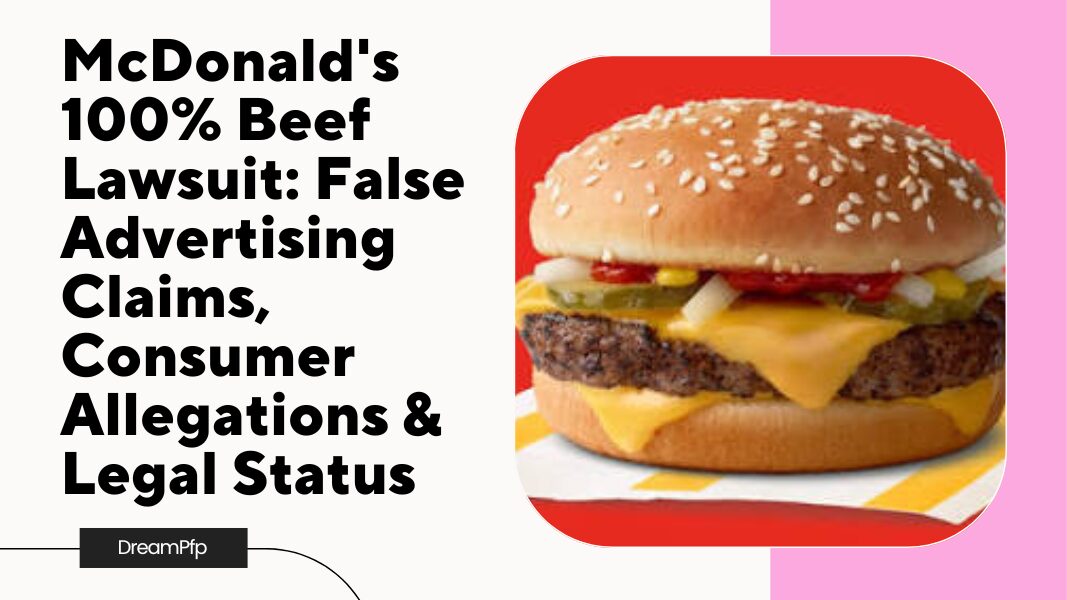
McDonald’s has long promoted its burgers with the well-known claim that its beef patties are made from “100% beef.” Over the years, that marketing message has attracted public attention, leading many consumers to search for a possible McDonald’s 100% Beef lawsuit and whether the company has faced legal action over its advertising.
Many online searches focus on whether a lawsuit was filed, if a class action exists, whether consumers received settlement payments, and whether the company’s advertising accurately reflects its products. Social media discussions and online forums have also contributed to ongoing questions about ingredients, food processing, and consumer protection laws.
This article explains what is publicly known about the controversy, distinguishes verified facts from online speculation, outlines how food-labeling lawsuits typically work, and discusses what consumers should understand when evaluating advertising claims involving food products.
Why the “100% Beef” Claim Became Controversial

McDonald’s has advertised for years that its hamburger patties are made from 100% pure beef. While the phrase appears straightforward, many consumers have questioned exactly what it means in practice. Those questions became more common as online discussions about food ingredients, preservatives, and manufacturing processes gained popularity.
One reason for the controversy is that consumers often interpret the phrase “100% beef” differently. Some people believe it means the entire finished burger contains only beef, while others understand it to refer only to the meat patty itself. This difference in interpretation has fueled confusion and online debate.
The issue also became more visible because food manufacturers frequently use processing techniques, freezing methods, seasoning, and preparation procedures that consumers may not fully understand. Although processing does not necessarily change the meat’s composition, discussions about manufacturing often create uncertainty about marketing claims.
Several factors contributed to increased public interest, including:
- Viral social media posts questioning fast-food ingredients.
- Consumer concerns about preservatives and additives.
- Misleading online rumors presented without evidence.
- Increased public interest in food transparency.
- Greater awareness of consumer protection laws.
Importantly, controversy alone does not establish legal wrongdoing. Public skepticism, consumer complaints, and online discussions may encourage legal review, but courts require evidence supporting any alleged violation of advertising or consumer protection laws.
For that reason, searches about a “McDonald’s 100% Beef lawsuit” often reflect consumer curiosity rather than confirmation that the company has been found liable for deceptive advertising.
What McDonald’s Says About Its Beef Patties
McDonald’s has consistently stated that the beef used in its classic hamburger patties consists of 100% USDA-inspected beef, with no fillers, extenders, or added preservatives in the patties themselves before cooking. According to the company, only a small amount of salt and pepper is added during preparation on the grill.
The company has also published educational materials explaining where its beef comes from, how it is processed, and the standards suppliers must follow. These efforts are intended to improve transparency and address common consumer questions.
It is important to distinguish between the beef patty and the finished burger. While the patty may be marketed as 100% beef, the completed sandwich naturally includes additional ingredients such as:
- The bun
- Cheese (when applicable)
- Pickles
- Onions
- Ketchup
- Mustard
- Other condiments
Similarly, processing methods such as grinding, freezing, transportation, and inspection do not necessarily alter whether the meat itself qualifies as beef.
Consumer concerns sometimes arise because ingredient lists for other menu items contain preservatives, flavorings, or additives. However, those ingredients should not automatically be confused with the composition of the beef patty itself.
When evaluating advertising claims, regulators generally examine exactly what statement was made, what a reasonable consumer would understand from that statement, and whether evidence supports allegations that the advertisement was misleading.
How Food Labeling Lawsuits Typically Work
Food-labeling lawsuits usually involve allegations that product packaging or advertising could mislead a reasonable consumer. These lawsuits often rely on federal food-labeling regulations together with state consumer protection laws.
Simply because consumers disagree with advertising does not mean a lawsuit will succeed. Plaintiffs generally must present evidence that an advertising statement was false, misleading, or likely to influence purchasing decisions.
In many food-labeling cases, courts examine questions such as:
- What exactly did the advertisement promise?
- Would an average consumer likely misunderstand the claim?
- Was the statement objectively false?
- Did consumers suffer measurable financial harm?
- Can scientific or factual evidence support the allegations?
Marketing phrases may also be evaluated differently depending on their wording. For example, claims involving “natural,” “organic,” “healthy,” or “100% beef” may each require different legal analysis based on applicable regulations and the specific facts of the case.
Courts also consider whether companies disclosed relevant information elsewhere on product packaging or through publicly available ingredient information.
Not every consumer complaint develops into litigation. Some disputes end with no lawsuit at all, while others may result in individual claims, class actions, settlements, or dismissal depending on the available evidence.
Understanding this legal framework helps explain why online discussions about McDonald’s advertising do not automatically establish that a company violated consumer protection laws or that compensation is available.
Was There an Actual McDonald’s 100% Beef Lawsuit?
One of the most common questions people ask is whether there has been an actual McDonald’s 100% Beef lawsuit alleging that the company’s advertising was deceptive. The answer requires separating online speculation from verified legal records.
As of publicly available information, there has not been a widely recognized class action or court judgment concluding that McDonald’s falsely advertised its standard hamburger patties as “100% beef.” While the company has faced various lawsuits over the years involving employment, hot coffee injuries, franchise matters, and other consumer issues, those cases are distinct from the “100% beef” claim.
Much of the online discussion appears to stem from:
- Social media posts repeating unverified claims.
- Misunderstandings about food processing.
- Confusion between ingredients in the beef patty and ingredients in the entire burger.
- General skepticism about fast-food marketing.
- Articles discussing food labeling laws in a broader context.
That does not mean legal challenges are impossible. Companies across the food industry regularly receive demand letters, consumer complaints, or lawsuits over advertising claims. However, each allegation must be supported by evidence and evaluated independently by the courts.
The absence of a confirmed judgment or nationwide settlement regarding the “100% beef” advertising claim is an important distinction. Consumers should rely on verified court filings and official statements rather than viral posts or unsupported online rumors.
| Common Question | Current Public Status |
|---|---|
| Major class action over the “100% beef” claim | No widely recognized confirmed class action |
| Court ruling declaring the claim false | No publicly confirmed ruling |
| Settlement fund announced | None publicly confirmed |
| Consumer claim form available | No confirmed claim program |
The Role of Consumer Protection Laws
Consumer protection laws are designed to prevent businesses from using deceptive or misleading advertising. These laws allow consumers, government agencies, and sometimes competitors to challenge marketing claims they believe are inaccurate or likely to mislead buyers.
At the federal level, advertising practices may fall under oversight by agencies responsible for preventing unfair or deceptive commercial conduct. In addition, every state has its own consumer protection statutes that allow legal action in appropriate circumstances.
For a claim involving advertising such as “100% beef,” a court would generally consider factors including:
- Whether the statement was factually accurate.
- How an ordinary consumer would interpret the advertisement.
- Whether important information was omitted.
- Whether consumers relied on the claim when making purchases.
- Whether measurable damages resulted.
These legal standards help distinguish genuine consumer protection cases from disagreements based solely on personal expectations.
Companies often defend such cases by presenting scientific evidence, product testing, manufacturing records, supplier documentation, and regulatory compliance information. Plaintiffs, in turn, must provide evidence supporting allegations that consumers were actually misled.
Because these cases are highly fact-specific, the outcome depends on the wording of the advertisement, available evidence, and the applicable laws—not simply on the popularity of an online controversy.
Why California Often Appears in Searches
California frequently appears in searches related to consumer lawsuits because it has some of the country’s most active consumer protection statutes. Many nationwide class actions involving food labeling, advertising, cosmetics, and dietary supplements are filed in California courts.
This does not necessarily mean that McDonald’s faced a California lawsuit specifically over its “100% beef” advertising. Instead, users often associate consumer litigation with California because numerous advertising cases originate there.
Several factors contribute to California’s reputation as a common venue for consumer lawsuits:
- Broad consumer protection statutes.
- A large population of consumers.
- Active plaintiffs’ attorneys handling class actions.
- Significant concentration of corporate business activity.
- Courts with substantial experience handling advertising disputes.
Search engines may also reinforce this association by suggesting related searches involving California whenever users research food-labeling lawsuits.
It is important not to assume that a search suggestion confirms the existence of a specific lawsuit. Search trends often reflect public curiosity rather than verified legal proceedings.
Consumers researching any legal claim should look for official court filings, judicial opinions, or credible reporting instead of relying solely on autocomplete suggestions or viral online content.
The Impact of Social Media and Reddit Discussions
Social media platforms and Reddit have played a significant role in spreading discussions about McDonald’s ingredients, food quality, and advertising claims. Some posts raise legitimate questions, while others repeat inaccurate or incomplete information.
Online discussions often mix verified facts with personal opinions, anecdotes, and speculation. As a result, readers may mistakenly believe that widespread discussion automatically confirms legal wrongdoing.
Common themes found in online conversations include:
- Questions about how beef is processed.
- Concerns regarding preservatives or additives.
- Comparisons with competitors’ ingredients.
- Debates about advertising language.
- Misunderstandings about what “100% beef” actually refers to.
Although these discussions can influence public perception, they are not evidence in a legal proceeding. Courts evaluate testimony, documents, expert opinions, laboratory testing, and other admissible evidence—not the number of social media posts discussing a topic.
Consumers should also recognize that individual experiences vary. A negative dining experience or disagreement with advertising does not automatically establish that a company violated consumer protection laws.
Social media can highlight issues that deserve further examination, but verified legal conclusions must come from official investigations, court decisions, or regulatory findings rather than online commentary alone.
Understanding the Difference Between Ingredient Claims and Processing Claims
One of the biggest sources of confusion surrounding the McDonald’s 100% Beef lawsuit involves the difference between ingredient claims and processing claims. Although these concepts sound similar, they address different aspects of how food is made and marketed.
An ingredient claim focuses on what a product contains. In this context, “100% beef” refers to the composition of the beef patty itself. Consumers often interpret this to mean the meat contains only beef rather than fillers or substitute meats.
A processing claim, on the other hand, relates to how the product is handled before reaching customers. Grinding, freezing, transportation, inspection, packaging, and cooking are all processing steps. These procedures do not necessarily change the meat’s primary ingredient.
For example, a product may still qualify as “100% beef” even if it has been:
- Ground into patties.
- Frozen for transportation.
- Stored under refrigerated conditions.
- Cooked using commercial equipment.
- Seasoned during preparation.
Because these concepts are different, legal disputes often focus on whether consumers could reasonably misunderstand the advertising—not simply whether processing occurred.
Courts evaluating advertising claims generally examine the specific wording, supporting evidence, and how an average consumer would interpret the statement in its full context.
Has There Been a McDonald’s 100% Beef Lawsuit Payout?
Many searches ask whether consumers have received compensation through a McDonald’s 100% Beef lawsuit payout. Based on publicly available information, there is no confirmed nationwide settlement providing compensation specifically related to the company’s “100% beef” advertising claim.
Settlement payments generally occur only after a lawsuit reaches a negotiated agreement or a court orders relief. Neither situation has been publicly confirmed for this specific advertising issue.
At this time:
| Settlement Question | Current Status |
|---|---|
| Settlement announced | No publicly confirmed settlement |
| Consumer payout | None publicly confirmed |
| Claim form available | No verified claim process |
| Payment date announced | None publicly confirmed |
Consumers should be cautious of websites claiming to offer settlement forms or compensation for an unverified case. Fraudulent websites sometimes use trending legal topics to collect personal information or charge unnecessary fees.
A legitimate settlement typically includes:
- Official court approval.
- A settlement administrator.
- Published legal notices.
- Clear eligibility requirements.
- Filing deadlines.
- Instructions for submitting claims.
If those elements are absent, consumers should verify the information before providing any personal details.
The Broader McDonald’s Beef Controversy
The discussion surrounding McDonald’s beef extends beyond the phrase “100% beef.” Over the years, consumers have raised broader questions about sourcing, nutrition, food quality, sustainability, and ingredient transparency.
Many of these concerns are not unique to McDonald’s. Similar debates have involved numerous restaurant chains and packaged food manufacturers as consumer expectations regarding food labeling continue to evolve.
Topics commonly discussed include:
- Beef sourcing practices.
- Animal welfare standards.
- Supply chain transparency.
- Nutritional content.
- Food processing methods.
- Environmental sustainability.
These conversations often influence purchasing decisions even when they do not result in litigation.
Businesses increasingly respond by publishing ingredient lists, answering frequently asked questions, improving supplier transparency, and expanding educational resources. Such efforts help consumers make informed decisions while reducing confusion about marketing claims.
The existence of public debate does not necessarily indicate legal liability. Instead, it reflects growing consumer interest in understanding how food is produced and marketed.
How Food Companies Respond to Advertising Challenges
When companies face questions about advertising, they often respond through a combination of public communication, legal defenses, and product transparency initiatives.
One common approach is providing additional information explaining how products are made and what advertising claims actually mean. Businesses may also update packaging, website content, or marketing materials to reduce the possibility of consumer misunderstanding.
If litigation occurs, companies typically defend themselves by presenting evidence such as:
- Ingredient specifications.
- Supplier certifications.
- Laboratory testing.
- Manufacturing records.
- Regulatory compliance documentation.
- Expert testimony.
In some situations, businesses choose to settle disputes without admitting wrongdoing. In others, courts dismiss claims if plaintiffs cannot establish that consumers were likely misled or suffered legally recognizable harm.
Each advertising dispute depends on its own facts, applicable laws, and available evidence. As a result, one food-labeling case should not automatically be viewed as predicting the outcome of another.
For consumers, reviewing official company statements alongside verified legal records provides a more accurate understanding than relying solely on social media discussions or online rumors.
What Consumers Should Learn From the Controversy
The discussion surrounding McDonald’s “100% beef” advertising highlights the importance of evaluating legal claims carefully rather than relying on headlines or viral content.
Consumers should distinguish between verified court proceedings, company statements, regulatory guidance, and online speculation. Not every controversy develops into a lawsuit, and not every lawsuit results in liability or consumer compensation.
Helpful practices include:
- Reading official ingredient information.
- Verifying news through reputable sources.
- Looking for actual court filings before assuming litigation exists.
- Avoiding unofficial settlement websites.
- Understanding that marketing phrases may have specific legal meanings.
Developing these habits can help consumers better evaluate future advertising disputes involving food products and other consumer goods.
Read: Kindig-It Lawsuit
Read: Blind Frog Ranch Lawsui
Read: Graveyard Carz Lawsuit
Read: Crepe Erase Lawsuit
Read: Janice Griffith Lawsuit
Read: Fischer Homes Lawsuit
Read: Sierra Mist Trademark Lawsuit
Read: Yellow Freight Lawsuit
Read: Breo Ellipta Lawsuit
Read: 100 Day Dream Home Lawsuit
Frequently Asked Questions
Is there an actual McDonald’s 100% Beef lawsuit?
There is no widely recognized public court ruling or nationwide class action establishing that McDonald’s falsely advertised its standard beef patties as “100% beef.” Many online discussions combine rumors, consumer questions, and broader debates about food labeling.
Has McDonald’s paid a settlement over its 100% beef advertising?
No publicly confirmed nationwide settlement or consumer compensation program has been announced specifically for the “100% beef” advertising claim.
Can consumers file a claim form for compensation?
Currently, there is no verified claim form or court-approved settlement administrator offering compensation related to this specific issue. Consumers should avoid unofficial websites claiming otherwise.
Why do people believe there was a lawsuit?
Confusion often comes from viral social media posts, search engine suggestions, and discussions about food ingredients. These sources can create the impression that litigation occurred even when no confirmed nationwide case exists.
Does “100% beef” mean the entire burger contains only beef?
No. The claim generally refers to the beef patty itself rather than the complete sandwich, which includes buns, condiments, cheese, vegetables, and other ingredients.
Can companies legally advertise products as “100% beef”?
Yes, provided the claim complies with applicable laws and accurately represents the product. If consumers believe an advertisement is misleading, legal challenges may be brought under consumer protection laws, but success depends on the specific evidence and legal standards involved.
Final Thoughts
The McDonald’s 100% Beef lawsuit remains a topic of significant public interest because it combines questions about food labeling, advertising, and consumer expectations. However, publicly available information does not confirm a nationwide class action settlement or court ruling declaring the company’s “100% beef” advertising false.
Much of the ongoing discussion stems from misunderstandings about ingredient claims, food processing, and social media speculation rather than verified legal findings. While consumer protection laws provide a framework for challenging misleading advertising when appropriate, each case must be supported by evidence and evaluated on its own facts.
Consumers researching this issue should rely on official company information, verified court records, and credible legal reporting instead of unconfirmed online claims. Understanding the difference between public controversy and established legal outcomes is essential for making informed decisions about any consumer dispute.
